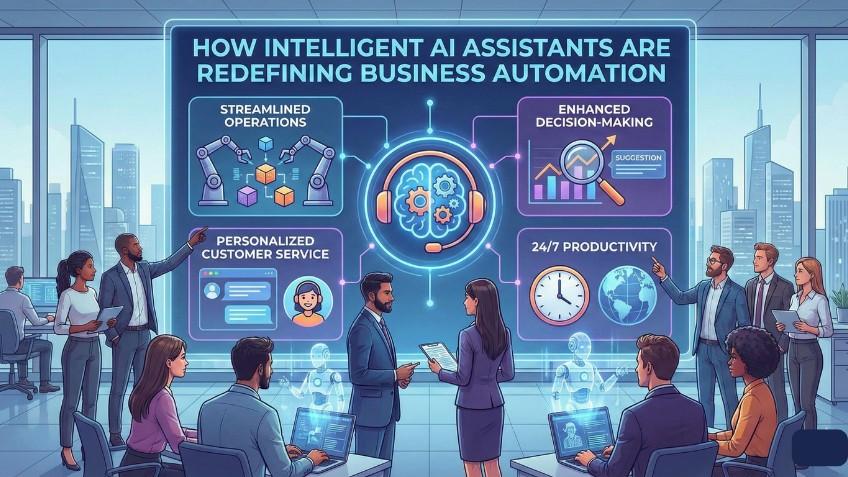
Business automation has moved far beyond simple rule-based systems. Today, organizations need intelligent solutions that can adapt, learn, and act in real time. This is where an AI assistants becomes a powerful enabler. By combining automation with contextual understanding, businesses can reduce manual effort, eliminate delays, and operate with greater precision. An AI assistant for business automation acts as a digital layer that connects people, data, and processes—allowing companies to grow efficiently without increasing operational complexity.
What Business Automation Means in Today’s AI Driven Workflows
In modern enterprises, business automation is no longer limited to automating repetitive tasks. It now involves orchestrating entire workflows across departments using intelligent systems. AI-driven workflows can analyze data, understand intent, and trigger actions automatically. An AI assistant supports this evolution by acting as a central interface for automation, enabling teams to interact with systems using natural language or simple commands. This approach improves speed, accuracy, and visibility across operations, making automation more accessible and impactful for businesses of all sizes.
How AI Assistants Reduce Manual Effort Across Business Processes
Manual processes slow down growth and introduce errors that impact productivity. An AI assistant reduces manual effort by automating routine activities such as reporting, monitoring, follow-ups, and task coordination. As an AI assistant for business automation, it integrates with existing tools and systems to ensure seamless execution without constant human intervention. Teams can rely on intelligent automation to handle operational workloads, allowing employees to focus on strategic initiatives, creative problem-solving, and customer engagement instead of repetitive tasks.
Hidden Productivity Losses Caused by Manual Business Operations
Many businesses underestimate how much productivity they lose due to manual operations. Time spent switching between tools, compiling data, and tracking progress manually adds up quickly. Without intelligent automation, decision-making is often delayed and teams operate reactively. An AI assistant addresses these challenges by providing real-time insights and automated execution. By eliminating friction and reducing dependency on manual coordination, business automation powered by AI helps organizations reclaim lost time and operate with greater efficiency and confidence.
Scaling Business Automation Without Increasing Team Complexity
As businesses grow, processes become more complex, often leading to increased headcount and operational overhead. Intelligent business automation offers a smarter alternative. An AI assistant enables scalable automation by managing workflows, monitoring performance, and adapting to changing business needs. This allows organizations to scale operations without adding unnecessary complexity to teams. By leveraging AI-driven automation, businesses can maintain agility, control costs, and ensure consistent execution even as demand and data volumes increase.
How AgentBheem Supports Intelligent Business Automation Systems
AgentBheem is built to function as an advanced AI assistant designed specifically for business automation. It integrates seamlessly with existing business systems, understands operational workflows, and delivers real-time insights that drive smarter execution. As an AI assistant for business automation, AgentBheem helps organizations automate processes, monitor key metrics, and make faster, data-driven decisions. By reducing manual effort and enabling intelligent automation at scale, AgentBheem empowers businesses to grow smarter, operate efficiently, and stay competitive in a rapidly evolving digital environment.