
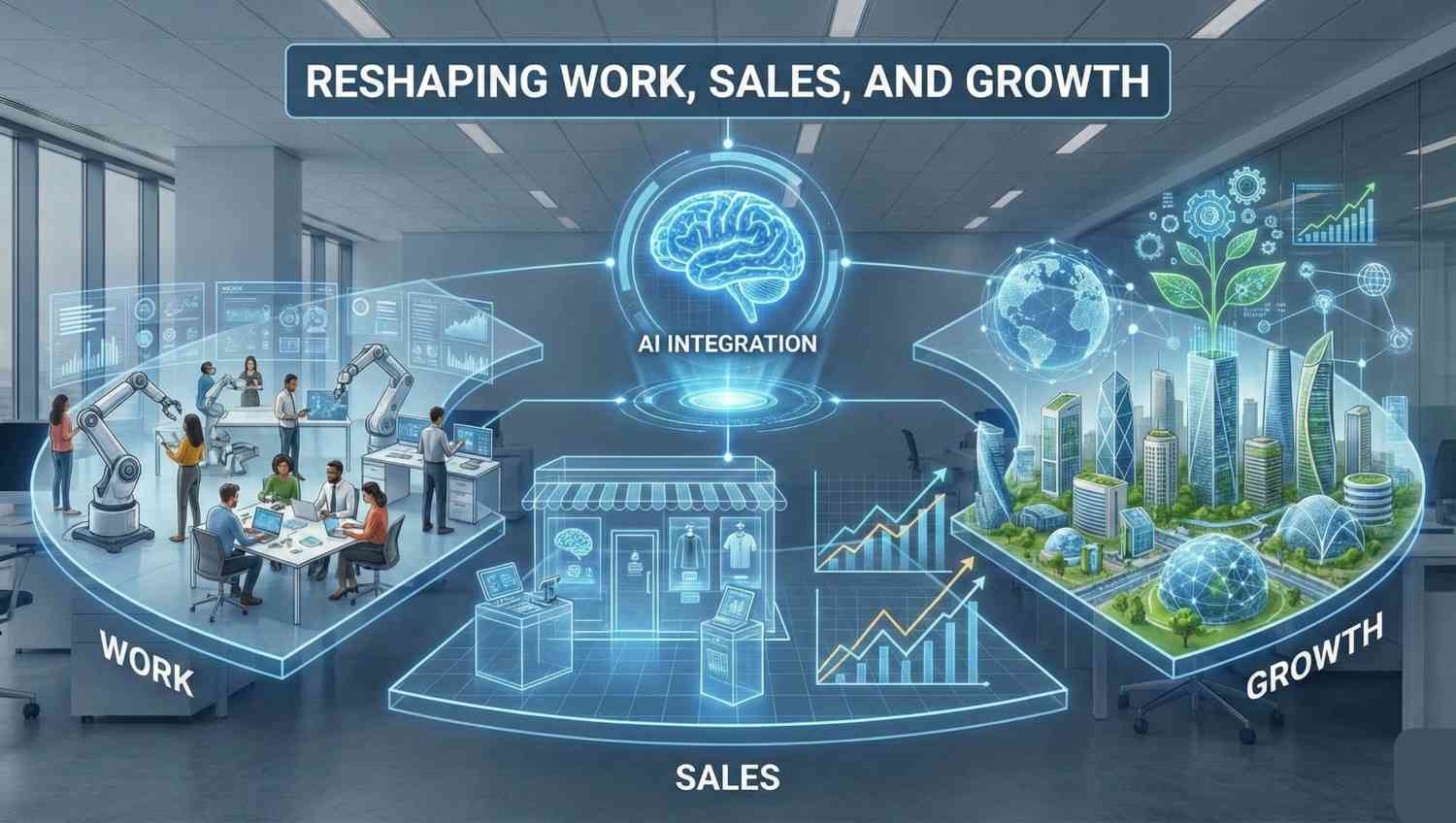
AI Agents began to shift from an idea to an actual application in 2025. The concept of AI Agents evolved from a proposed idea to being used in nearly every vertical across business, product & platform markets, as well as for business automation. AI Agents provided companies with an opportunity to utilize AI as more than just a passive tool; they instead allowed companies to use AI as an active participant in their decision-making and execution processes. The introduction of Agent Bheem in 2025 symbolised a sea-change in the perception of agentic AI being at the core of designing a more intelligent and automatable system.
From AI that helps to AI that works together
How people interacted with AI changed a lot in 2025. One of the big changes was instead using AI agents as a tool, which businesses used them partner this increases efficiency ten times better. A modern AI business assistant could understand what someone meant, make decisions in the middle, and only ask for human judgment when it was really needed. This made things less mentally taxing and let teams focus on strategy while the AI assistant took care of execution. Agent Bheem shows this collaboration-first model by making AI a real business partner instead of just a tool.
AI Agents Integrated Into All Business Platforms
AI agents were no longer limited to stand-alone applications by the end of 2025. They were integrated into databases, analytics dashboards, CRM systems, and communication tools, among other enterprise platforms. The aim of AI is to bring uniformity to different sectors organisation which will lead to a better future. Real-time coordination was made possible by this cross-platform intelligence, which also established the foundation for ongoing AI automation powered by real-time data.
Multi-Agent Systems’ Ascent
The introduction of multi-agent architectures was another significant development of 2025. Specialized agents collaborated, with one concentrating on data analysis, another on communication, and a third on execution, rather than a single AI managing everything. These agents enabled scalable and robust AI automation for businesses by coordinating through common objectives and event-driven logic. This model is used in Agent Bheem’s architecture, which enables enterprise-grade reliability and modular growth.
AI Agents provides Insights and Business Intelligence
AI agents’ function in AI business intelligence became more evident as they developed. Instead of providing static reports, agents started continuously analyzing operational data and providing real-time analytics and insights. This change made it possible for leaders to react to opportunities, risks, and shifts in performance more quickly. A virtual assistant with AI capabilities could now highlight anomalies, summarize trends, and assist in making more informed decisions for the entire company.
2026’s Challenges for AI Agents
Although 2025 demonstrated the effectiveness of AI agents, 2026 presents new difficulties. As agents operate in unpredictable environments, orchestration complexity becomes a major concern. When agents are granted autonomy, security, access control, and data privacy become crucial. Organizations must comprehend how and why an AI agent for business takes particular actions, particularly in regulated industries. This presents another significant challenge.
Keeping Control and Autonomy in Check
As AI agents become more sophisticated, striking a balance between their autonomy and human supervision becomes crucial. Platforms with robust governance will be more successful in 2026 than those with unbridled autonomy. Agent Bheem places a strong emphasis on controlled autonomy, in which agents operate autonomously while adhering to explicit guidelines, audit trails, and approval procedures. This guarantees that AI intelligence stays reliable and in line with corporate objectives.
Interoperability and Standardization
The absence of universal standards for agent communication and interoperability is a significant obstacle. Businesses will require modular designs and open integrations as adoption grows. Needs. Adaptability is the key for businesses to grow because AI automation provide servs the long-term goals of the company, which guarantees success.
Balancing Autonomy and Control with an AI Agent
“As AI agents increase in capability, the need for building a balance between autonomy and human oversight becomes the key.” In the year 2026, it shall not be the successfully operating platforms with autonomous capabilities but the effectively governed ones, according to Agent Bheem, with the focus on “controlling autonomy” in such a manner that the agents “act independently but with rules, audit trails, and approvals.”
Standardization and Interoperability
A big challenge that lies ahead is that there are no standard communication mechanisms between agents. This is because, with growth in adoption, there is a need for openness in integrations. An interoperable platform will scale much quicker in order to meet different requirements that lie ahead in making a strong business automation strategy.